Four Hands: Historical notes
20 June 2026
I wrote a an essay on the pleasures of studying the kuzushiji text of 牛屋雑談: Four Hands: Between us, a whole reader. The book is also referred to as Aguranabe. These are the citations that support the historical facts in that essay.
Aguranabe went through numerous editions — from the original woodblock-printed fascicles through moveable type, pocket editions, and eventually electronic text. 1
Learn about how books were reproduced using woodblocks.2 牛屋雑談 was published in chū bon size (about 5”x7”).
Watch Capucine Korenberg, a scientist at the British Museum, recreate the woodblock process. Although she is working on ukiyo-e, the basic technique is the same for books. Simpler, because there’s only one color.
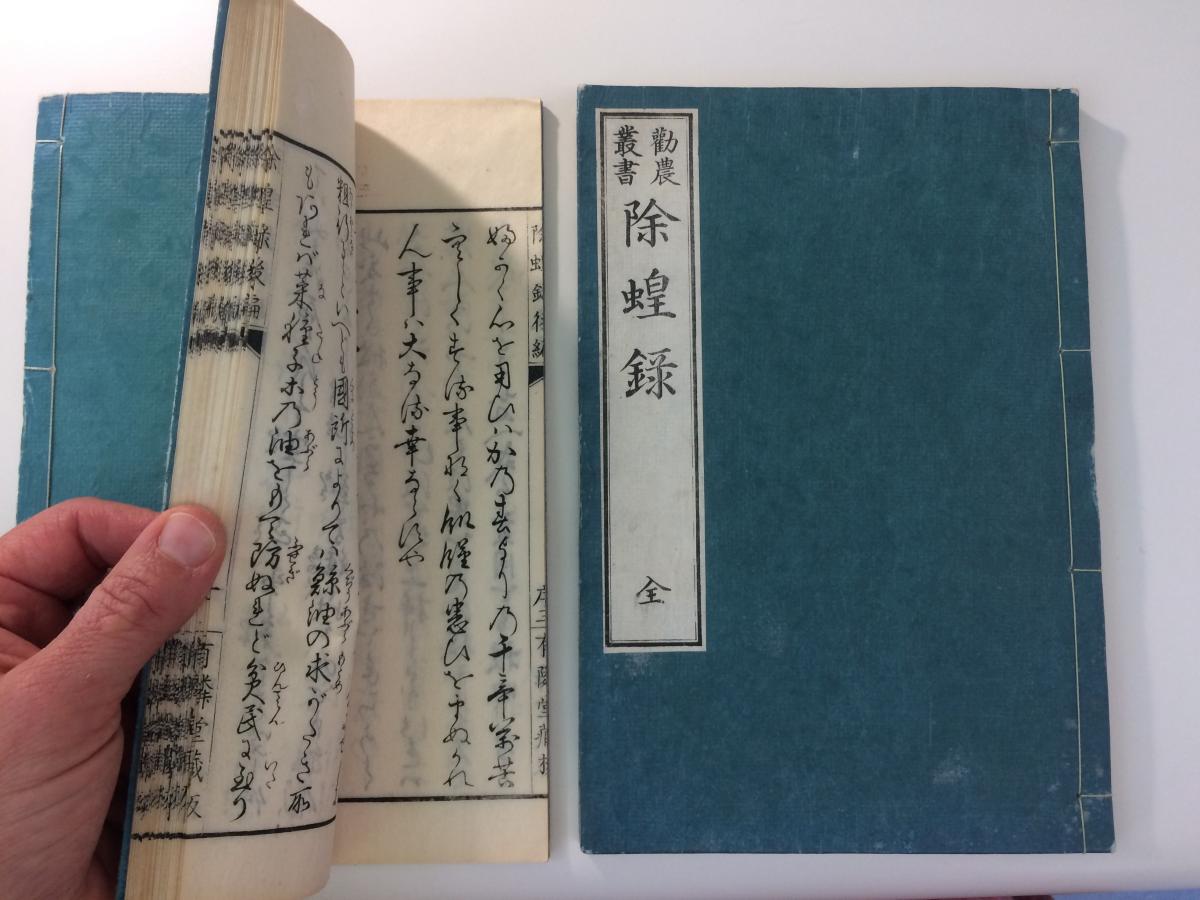
A similarly bound book (Hagley Museum and Library: Traditional Japanese Bookbindings)
Donald Keene translated parts of 牛屋雑談 to English in 1954. 3 I found a scan at https://www1.udel.edu/History-old/figal/Hist370/text/er/beefeater.pdf
Customers at early Meiji beef shops sat on tatami mat floors, not chairs. 4
Fukuzawa Yukichi’s 1870 pamphlet Nikushoku no setsu urged Japanese readers to eat beef on grounds of health and national strength. 5
Beef was not widely eaten in Japan before the Meiji period.6
Before 1872, ice in Japan was imported from Boston, a journey of some six months. Domestic ice first came to market in 1872, when Nakagawa Kahei began shipping ice from Hokkaido to Yokohama.7
In January 1872, the emperor ate beef publicly, effectively ending a twelve-century imperial prohibition on consuming meat.8
By 1877, Tokyo reportedly had over 550 beef shops.9
The rickshaw was invented in 1869 and had only just entered production when Aguranabe was published. It was possible only after the Meiji government lifted the Tokugawa-era ban on wheeled vehicles.10
Very few Japanese today can read this book, though it was a hit only 155 years ago.11
Footnotes
Wetherall, William. “Kanagaki Robun’s Aguranabe.” Yosha Bunko, 2008. https://www.yoshabunko.com/nishikie/articles/Aguranabe.html. Accessed June 21, 2026.↩︎
Hioki, Kazuko. “Characteristics of Japanese Block Printed Books in the Edo Period: 1603–1867.” Library Faculty and Staff Publications 58. University of Kentucky, 2009. https://uknowledge.uky.edu/cgi/viewcontent.cgi?article=1058&context=libraries_facpub. Accessed June 21, 2026.↩︎
Kanagaki Robun. “The Beefeater.” Trans. Donald Keene. In Modern Japanese Literature: An Anthology. Ed. Donald Keene. New York: Grove Press, 1956, pp. 31–33.↩︎
Interior scene depicted in Kanagaki Robun, Aguranabe, vol. 1 (Seishidō, 1871). Reproduced in Nippon.com, https://www.nippon.com/en/features/c03911/. Accessed June 21, 2026.↩︎
福沢諭吉。「肉食之説」1870年。青空文庫。 https://www.aozora.gr.jp/cards/000296/files/47343_42900.html. 2026年6月21日閲覧。Trans. Michael Bourdaghs as “On Eating Meat.” https://www.bourdaghs.com/fukuzawa.htm. Accessed June 21, 2026.↩︎
Wikipedia contributors. “History of Meat Consumption in Japan.” Wikipedia, April 2026. https://en.wikipedia.org/wiki/History_of_meat_consumption_in_Japan. Accessed June 21, 2026.↩︎
Sakuraco. “Kakigori: Unlocking the Secrets of the Shaved Ice Delight.” Sakuraco Blog. https://sakura.co/blog/kakigori-unlocking-the-secrets-of-the-shaved-ice-delight. Accessed June 21, 2026.↩︎
Wikipedia contributors. “History of Meat Consumption in Japan.” Wikipedia, April 2026. https://en.wikipedia.org/wiki/History_of_meat_consumption_in_Japan. Accessed June 21, 2026.↩︎
Nippon.com. “Human-Animal Ties: Japanese Takes in Both Life and Death.” January 2026. https://www.nippon.com/en/features/c03911/. Accessed June 21, 2026.↩︎
Wikipedia contributors. “Rickshaw.” Wikipedia, 2026. https://en.wikipedia.org/wiki/Rickshaw#Japan. Accessed June 21, 2026.↩︎
Kuzushiji was removed from the Japanese elementary school curriculum in 1900. Lamb, Alex. “How Machine Learning Can Help Unlock the World of Ancient Japan.” The Gradient, November 17, 2019. https://thegradient.pub/machine-learning-ancient-japan/. Accessed June 21, 2026. See also: Center for Open Data in the Humanities (CODH). “KuroNet Kuzushiji Recognition Service.” https://codh.rois.ac.jp/kuronet/. Accessed June 21, 2026.↩︎